
Hawaiian, Alaska airlines to use locally made biofuel





Hawaiian Airlines and Alaska Airlines expect to begin running some of their planes partly on biofuel produced in Hawaii early next year.
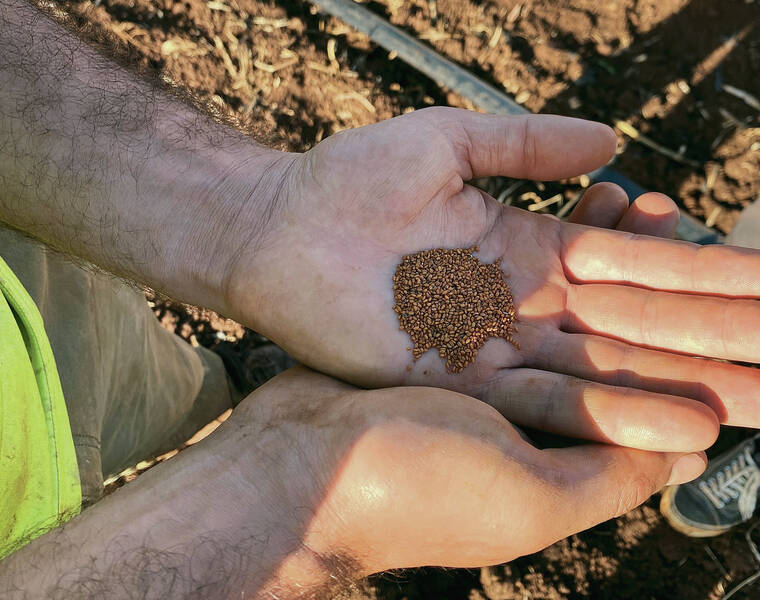
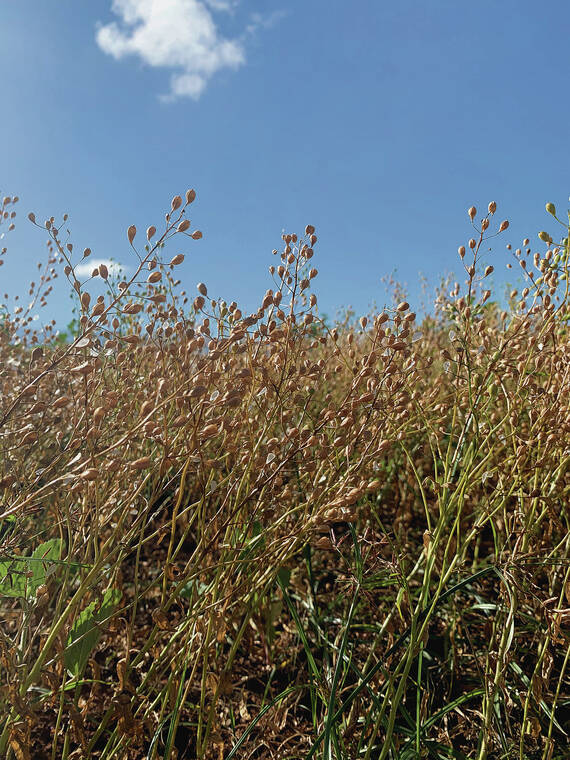
The sister airlines owned by Alaska Air Group also plan to invest in a joint venture between several companies including fuel refinery operator Par Hawaii trying to establish Camelina sativa, also known as false flax, as a major crop in the state for producing sustainable aviation fuel and feed for cattle and chickens.
Hawaiian and Alaska, which publicly announced the plans Wednesday, say the related ventures will expand their use of sustainable aviation fuel that reduces greenhouse gas emissions and helps the state meet a goal to have 100% of energy generation from renewable sources by 2045.
“As Hawaii’s airline, we have a responsibility to reduce our environmental impact while continuing to provide essential air service that connects our communities and strengthens our economy,” Alanna James, sustainability innovation director at Hawaiian and Alaska, said in a statement. “Our company has a long-term strategy to reach net zero carbon emissions, and sustainable aviation fuel is essential for us to get there.”
Hawaiian began working with Par Hawaii in 2022 to study the commercial viability of locally produced sustainable aviation fuel, or SAF. That work became integrated with Alaska when Alaska Air Group completed its $1.9 billion acquisition of Hawaiian in September 2024.
Meanwhile, Par Hawaii, a subsidiary of Houston-based Par Pacific Holdings Inc., has been working over the past few years to convert part of its Kapolei fuel refinery to produce a variety of renewable fuels to be used for electricity generation as well as for air, ground and marine transportation.
Par Hawaii initially invested $90 million to develop the facility, and in October sold a 36.5% stake in the project to a joint venture between two Japanese companies, Mitsubishi Corp. and ENEOS Corp., for $100 million.
The project will be the largest renewable fuels manufacturing facility in the state, with a capacity to produce about 61 million gallons of fuel annually ideally from locally grown oil-producing crops but also from imported plant and waste oils.
Par Hawaii’s renewable fuel production plant is designed to make up to 60% SAF, and is expected to begin operations and deliver its first fuel to Hawaiian and Alaska sometime between January and March.
However, almost all off the fuel produced at the facility initially will be renewable diesel that Par Hawaii plans to sell on the West Coast of the mainland.
Still, Par Hawaii President Eric Wright said in a statement that the company didn’t think progress to produce SAF would be as quick after the 2022 study began with Hawaiian.
“With renewable fuel production coming online in early 2026, it’s exciting to see the results of our team’s hard work,” he said. “These fuels will have up to 80% lower carbon emissions compared to conventional fuels. This would not have been possible without a shared vision for our islands and our great teamwork.”
When renewable fuel production begins early next year, the feedstock will be from canola oil along with used cooking oil and rendered animal fat imported from Canada, according to Par Hawaii.
Hawaiian and Alaska, the latter of which set an ambitious goal in 2021 to achieve net-zero carbon emissions by 2040, already use some SAF, but not any produced in Hawaii.
SAF is a “drop-in” fuel, meaning it works with existing airplane engines and fuel infrastructure. Current use, however, is limited to a maximum 50% blend with conventional jet fuel made from petroleum, and 100% SAF use may be several years away.
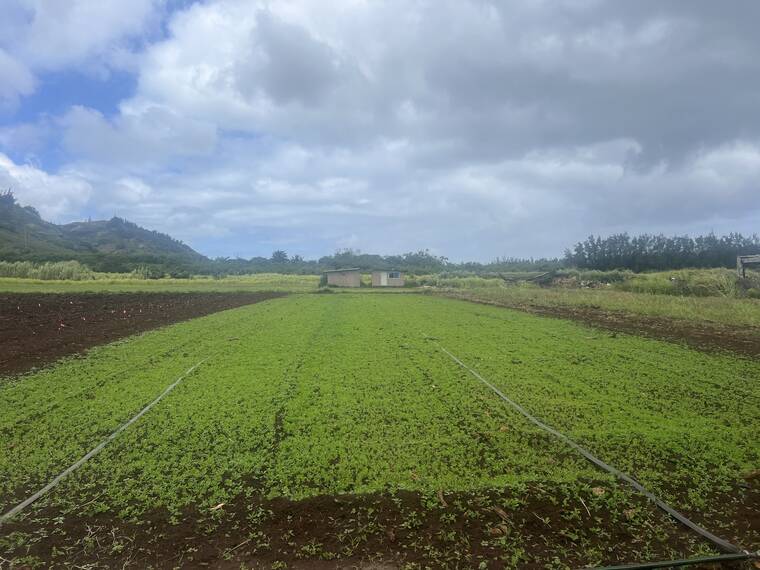
To make SAF in Hawaii using local feedstock, Honolulu-based natural resources conservation firm Pono Pacific is leading work to establish Camelina as a major crop from which oil can be extracted for Par Hawaii’s renewable fuel production facility.
Pono Pacific in 2023 collaborated with the Hawaii Agriculture Research Center to test 50 non-GMO Camelina varieties to see what would grow best in different conditions around the state.
According to the announcement by Hawaiian and Alaska, Camelina crop trials were conducted by Pono Pacific on four islands in partnership with Aloun Farms, Maui crop producer Mahi Pono and Meadow Gold Dairy. Pono Pacific also has worked with Hawaii cattle and livestock operators to explore the use of Camelina seedcake after oil extraction as animal feed.
Early next year, Pono Pacific plans to accelerate its work on Camelina, which the company said can reach maturity in eight to nine weeks, is pest-resistant and can be grown in rotation with food crops.
“Camelina represents a rare opportunity for Hawaii to build a true circular-economy model around renewable fuels,” Chris Bennett, Pono Pacific vice president of sustainable energy solutions, said in a statement.
“We will explore food crops that can be grown alongside Camelina to increase food security as well,” Bennett added. “It’s a win for our economy, a win for local agriculture, and a win for the environment — an example of how Hawaii can lead the way in innovative, homegrown climate solutions.”
Regardless of whether Pono Pacific’s expectations for Camelina are realized, Hawaiian and Alaska are slated to become the first customers of locally produced SAF under their arrangement with Par Hawaii.
How much SAF the two airlines have committed to use is not being disclosed. James described the initial amount as “relatively small.” She also noted that SAF is two to three times more expensive than regular jet fuel, and that the supply is limited.
The two airlines consume more than 200 million gallons of jet fuel in Hawaii annually, with transpacific flights representing the vast majority of that use.
James said there will need to be strong collaboration across airlines, fuel and feedstock producers, investors, government and others along with supportive policies that include state incentives to grow the SAF industry and reach decarbonization goals.
The Hawaii Department of Transportation in October finalized a plan to largely eliminate greenhouse gas emissions from ground, air and ocean transportation vehicles in the state by 2045, and acknowledges that achieving the goal will result in higher costs for industries and consumers.
HDOT’s plan includes a priority to establish state tax credits to incentivize the import, production and use of SAF for long-haul and interisland flights.
The report notes that other states have credits ranging from 75 cents to $1.50 per gallon.
“For SAF to be deployed in Hawaii at the scale needed to achieve significant strides towards decarbonization, similar policies are essential,” the report states.
HDOT’s goal is to reach 50% SAF use by 2035, followed by 75% in 2040 and 100% by 2045.
Ed Sniffen, HDOT director, said in a statement that the agency applauds Hawaiian and Alaska airlines, Par Hawaii and Pono Pacific for achieving what he described as an “important step to establish a locally based, lower-emissions supply chain for aviation fuel that supports our state’s clean energy goals.”


Get the Latest News
Most Popular
